science New
Pibbit's Greenhouse
Plant a seed, turn the days, and watch it grow
Guess first, then drop it in the tub and see
Free to play · No ads · No sign-up
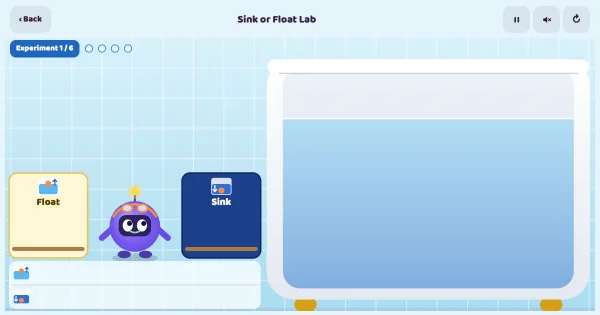
Pibbit the robot holds up something from around the house, an apple, a key or a big pumpkin, and your child decides: will it float or sink? They put it on the Float shelf or the Sink shelf, then drop it in the bath and watch. The coin plunges, the grape drifts down slowly, the ice cube floats with most of it hidden under the water. Six experiments build up to the tricky ones: an orange that floats until you peel it, clay that sinks as a ball but floats as a boat, and an egg that rises when you stir salt into the water. A wrong guess isn't a mistake here. Pibbit calls it a surprise, and explains what happened.
Sink or Float Lab is one of our free science & nature games for kids — play it right here in your browser, or browse all our free online games. It is also in our games for toddlers and preschoolers collection.
Sink or Float Lab follows the same loop science lessons use: guess first, test it, then talk about what happened. Every object starts with a prediction on a shelf, every result goes onto a small chart with a star or a light bulb, and the end of the game shows the whole lab report. Children who are used to quizzes are often surprised that a wrong guess still earns something. Here it's the most interesting part.
The objects are chosen to break the idea most young children start with, that heavy things sink and light things float. A big pumpkin floats while a tiny grape sinks, an orange floats until its peel comes off, and the same lump of clay sinks as a ball but floats as a boat. By the end, the idea Pibbit keeps coming back to is the right one: it's about how heavy something is for its size. Each object behaves the way the real thing does, and the ice cube floats with about nine tenths of it under the water, just as ice really does.
For teachers and homeschooling parents, here is where Sink or Float Lab lines up with what children are taught at school:
Made for ages 3 to 8. Three- and four-year-olds can play by ear: Pibbit asks every question out loud and nothing can go wrong, so they can just enjoy the splash. Five- to eight-year-olds get more from the later experiments, especially loading the clay boat with marbles and making an egg float with salt. It's a good one to play side by side and argue about the guesses.
Do one of the experiments for real afterwards: an orange in a bowl of water, then the same orange peeled.
When they guess wrong, ask what surprised them. Changing your mind because of evidence is the skill this game is really about.
Try the salt one in a tall glass. You'll need a lot more salt than you think, which is a good lesson in itself.
Yes — Sink or Float Lab is completely free to play here in your browser. There's no sign-up, no download and nothing to buy.
Drag or tap. Drag objects onto a shelf and into the tub; drag down on the clay to squash it and up on its sides to make a boat; tap the marble jar and the salt shaker. Listen to Pibbit's question, then drag the object to the Float shelf or the Sink shelf. Tapping a shelf works too.
No. Sink or Float Lab runs in any web browser on a phone, tablet or computer — just open the page and play. Nothing installs.
Sink or Float Lab is made for ages 3 to 8. It helps children practise making a prediction, testing it and recording the result and learning that size alone doesn't decide whether something floats while they play.
Plant a seed, turn the days, and watch it grow
Build a machine, test it, fix it, deliver the goods
Drag the shapes to build a rocket!
Swap the tiles to rebuild the picture!
Drag each shape into its matching hole!
Tap the friend wearing the right color!
Math, reading, spelling, flashcards and coloring pages — all free in our Learning Center.