words
Word Guess
Guess the hidden word one letter at a time!
Build words so Pibbit can talk again
 iPhone & iPad

In the app
It plays offline, there are no ads, and you pay once.
Free download with 33 games. A one-time $9.99 unlock opens Sound Bricks and 73 more; no subscription, and the purchase sits behind a grown-up check.
Download on the App StoreWant to play something right now? These are free here:
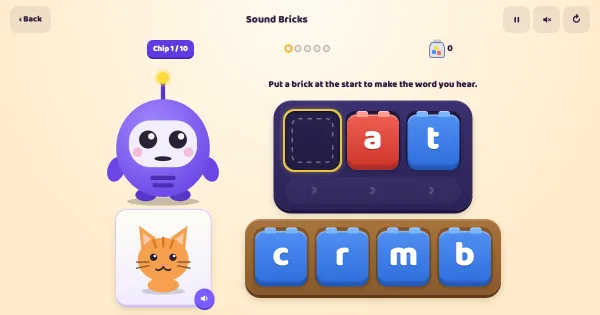
Pibbit the robot has a broken talking chip, so he can only say words a child builds for him. Each word is a picture and a spoken word: the child drags letter bricks into his speaker to spell it, then slides a finger under the word to hear him read it. Most words only change one brick from the last one, cat to hat to bat, which is how children learn that changing a sound changes the word. Put in the wrong brick and Pibbit reads what you actually made, so a mistake turns into a listening lesson. Ten chips, 47 short-vowel words, no timer.
Sound Bricks is one of our words & letters games for kids. This one plays in the iPhone and iPad app rather than in the browser, but 33 of our games are free to play right here — browse the full library to find them.
Sound Bricks practises the two halves of early reading. Building a word from its sounds is spelling, and teachers call it encoding. Reading the built word back by blending its sounds is decoding. Children who do both, back and forth, tend to read sooner than children who only do one.
The words follow the order many phonics programmes use: the -at and -an families first, then each short vowel, then swapping the middle sound, then adding a letter (pin to spin) and two-letter starts like sl and dr. Every word is spelled the way it sounds. There are no tricky words, silent letters or long vowels yet.
For teachers and homeschooling parents, here is where Sound Bricks lines up with what children are taught at school:
Best for ages 4 to 7. Four-year-olds who know a few letter sounds can manage the first three chips, where only the first brick changes, especially with an adult beside them. Five- and six-year-olds in kindergarten and first grade get the most from the later chips, where they spell whole words and spot which sound changed. Beginning Sounds is a good warm-up if a child doesn’t know letter sounds yet.
Sound out the word together before your child starts building. Stretching it, mmmaaap, helps them hear each part.
When Pibbit says the wrong word, don’t jump in. Ask “what did he say?” and let your child hear the difference.
After a chip, read the words in the jar aloud together and make up a silly sentence with three of them.
Sound Bricks is part of Pibbit, our app for iPhone and iPad. The app is free to download and 33 of its games are free; Sound Bricks is one of the 74 that open with a single $9.99 purchase. You pay once, there is no subscription, and the purchase sits behind a grown-up check.
Not on the website. Sound Bricks plays in the Pibbit app, where it works offline and has no ads. If you want something to play in the browser right now, Word Wheel, Word Grid and Who Am I? are free on this site.
Drag bricks with a finger. Tap a brick to hear it. Slide under the word to read it. Listen to the word, or tap the picture to hear it again.
Sound Bricks is made for ages 3 to 8. It helps children practise spelling short words by their sounds (encoding) and blending sounds into a word (decoding) while they play.
Guess the hidden word one letter at a time!
Unscramble the mixed-up letters into a word!
Read the clue, fill in the word
Find the word that sounds the same at the end
Turn one word into another, one letter at a time
Which picture starts with this letter?
Math, reading, spelling, flashcards and coloring pages — all free in our Learning Center.