words
Word Search
Find all the hidden words in the letter grid!
Listen to the little robot and do what he asks
Free to play · No ads · No sign-up
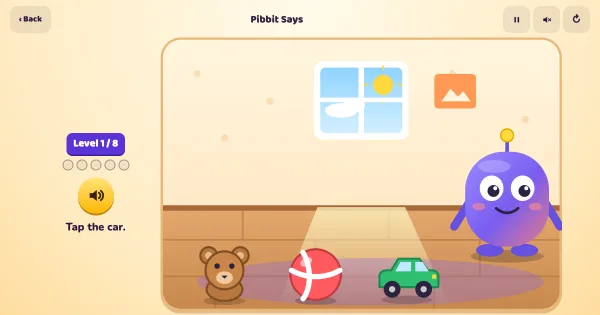
Pibbit the robot sits in his playroom with a duck, a ball, a teddy and a few other toys, and asks your child for things out loud: tap the duck, put the ball under the bed, give me the biggest block, tap the second duck in the line. There's nothing to read. When a toy lands in the wrong spot, Pibbit says where it actually went ("Hmm, that's on the bed") and asks again, and after two tries the right toy starts to glow. Eight short levels move from naming toys to big and little, on, under, in and next to, counting cookies, first and last, and finally two instructions in a row. Hand him a ball and he falls over. Hand him the teddy and he hugs it.
Pibbit Says is one of our free words & letters games for kids — play it right here in your browser, or browse all our free online games. It is also in our games for toddlers and preschoolers collection.
Pibbit Says is about listening comprehension, the part of early language that's easy to overlook because it doesn't show. Before children talk about "under" or "between" they first have to understand those words when someone else uses them, and following a spoken direction is one of the things preschool and kindergarten teachers check most often. Every instruction here is spoken, so the game measures listening, not reading.
The words are the small ones that carry a lot of meaning: on, under, in and next to; big, little, biggest and smallest; most and fewest; first, second, third and last. When a child gets one wrong, the game names what they actually did, so a ball dropped on the bed earns "that's on the bed" rather than a buzzer. Hearing the difference between what they did and what was asked is how the words sink in. The last level strings two directions together, the kind of "first put your shoes on, then get your coat" that young children find surprisingly hard.
For teachers and homeschooling parents, here is where Pibbit Says lines up with what children are taught at school:
Made for ages 3 to 5. Most three-year-olds can do the first two levels alone and enjoy Pibbit's reactions; the position words and the cookie counting suit four-year-olds; the line of ducks and the two-step level are a fair stretch for a five-year-old. There's no timer and no way to lose, so a younger child can simply keep going until it clicks.
Play the two-step level together and ask your child to say both steps back before touching anything.
If "fewest" is new, use your own fingers: three here, one there, which has fewer?
Notice which words they pause on. Those are the ones to use in everyday talk this week.
Yes — Pibbit Says is completely free to play here in your browser. There's no sign-up, no download and nothing to buy.
Tap a toy, or drag it. The toy lifts above your finger while you drag, and the spot it will land on lights up. Press Play and listen. Pibbit says what he wants. Tap the yellow speaker, or Pibbit himself, to hear it again.
No. Pibbit Says runs in any web browser on a phone, tablet or computer — just open the page and play. Nothing installs.
Pibbit Says is made for ages 3 to 5. It helps children practise following one-step and two-step spoken directions and position words: on, under, in, next to while they play.
Find all the hidden words in the letter grid!
Drag each shape into its matching hole!
Tap the friend wearing the right color!
Read the clues, work out who's who
Read the clue, fill in the word
Find the word that sounds the same at the end
Math, reading, spelling, flashcards and coloring pages — all free in our Learning Center.