numbers
Big and Small
Find the biggest — or the smallest
Cut the food so every friend gets the same
 iPhone & iPad

In the app
It plays offline, there are no ads, and you pay once.
Free download with 33 games. A one-time $9.99 unlock opens Fair Share Kitchen and 73 more; no subscription, and the purchase sits behind a grown-up check.
Download on the App StoreWant to play something right now? These are free here:
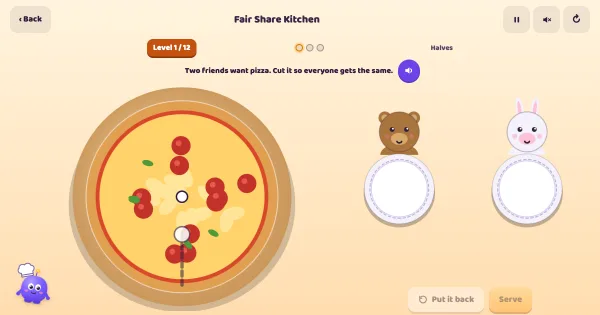
Pibbit runs a little café, and his animal friends are hungry. Swipe to cut pizzas, cakes and chocolate bars, then serve them. If the pieces are fair, everyone cheers. If not, the friend with the smallest slice holds it up and says so. Later orders ask for a fraction, like two thirds of a pizza, and get judged by how much is on the plate, so two fourths counts as one half. The last levels hide the plates under covers and ask which fraction is bigger from the numbers alone. Twelve levels, from halves to sixths.
Fair Share Kitchen is one of our numbers & maths games for kids. This one plays in the iPhone and iPad app rather than in the browser, but 33 of our games are free to play right here — browse the full library to find them.
Fair Share Kitchen starts where fractions really start: sharing something fairly. Before a child can make sense of 1/3, they need to know what “three equal parts” looks like, and that equal means the same amount, not just the same number of pieces. Cutting a pizza for three friends and watching one of them complain makes that stick.
From there it moves to naming fractions (serve two thirds of the pizza), to equivalence (the pizza is cut in eight, so how many slices make a half?), and to comparing fractions. In the last levels the plates are covered, so the child has to reason from the numbers and then lift the covers to check.
For teachers and homeschooling parents, here is where Fair Share Kitchen lines up with what children are taught at school:
Made for ages 6 to 10, first to fourth grade. Six- and seven-year-olds play the first five levels, which are all about fair cutting and match first- and second-grade geometry. The ordering, comparing and equivalent-fraction levels line up with third grade, and the covered-plate comparisons will make some fourth graders stop and think.
When someone says “not fair”, ask your child how they could tell. Bigger pieces versus more pieces is the whole point.
Ask “would you rather have one third or one fourth of a pizza?” before playing the comparing levels. Many children pick one fourth because four is bigger.
Let your child explain why two fourths is the same as one half. Saying it out loud is where it clicks.
Fair Share Kitchen is part of Pibbit, our app for iPhone and iPad. The app is free to download and 33 of its games are free; Fair Share Kitchen is one of the 74 that open with a single $9.99 purchase. You pay once, there is no subscription, and the purchase sits behind a grown-up check.
Not on the website. Fair Share Kitchen plays in the Pibbit app, where it works offline and has no ads. If you want something to play in the browser right now, Quick Math, 2048 and Higher or Lower are free on this site.
Swipe to cut. Drag pieces onto plates. Tap a plate to choose it. Count the friends at the counter.
Fair Share Kitchen is made for ages 6 to 12. It helps children practise splitting a shape into equal parts and naming halves, thirds, fourths, fifths and sixths while they play.
Find the biggest — or the smallest
Pack cookies into boxes and crates to learn place value
Practise number facts, then race the clock when ready
Count the objects and pick the right number!
Pop the balloon with the right answer!
Read the clock and pick the right time!
Math, reading, spelling, flashcards and coloring pages — all free in our Learning Center.